
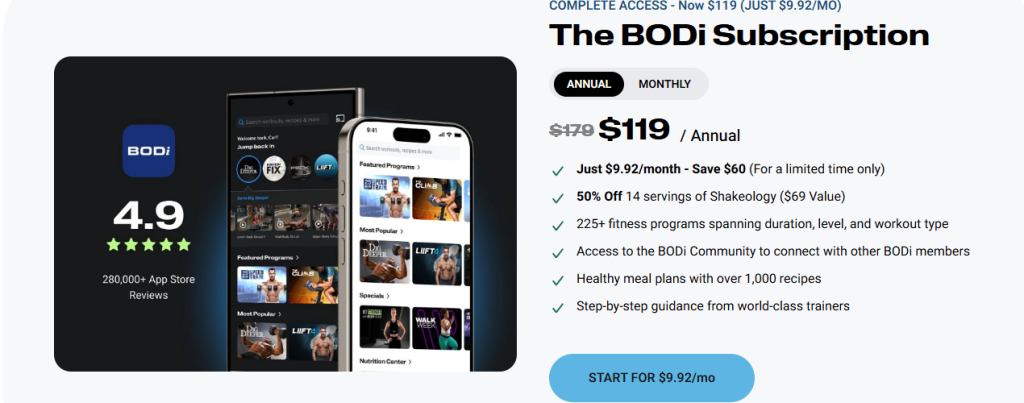
BODi offers a broad digital fitness and nutrition ecosystem rather than functioning as a simple library of exercise videos. The platform combines structured workout programs, individual classes, nutrition resources, community features, and access across common devices, creating a subscription designed around ongoing home and on-the-go training. Current BODi information lists more than 225 trainer-created programs and over 9,500 workouts covering areas such as strength, HIIT, cardio, yoga, Pilates, mobility, and shorter sessions. The service also includes nutrition plans and more than 1,000 recipes, while newer options such as 10 Minute BODi address users who prefer brief daily workouts. This review examines BODi as a complete digital fitness service, considering the organization of its content, range of training formats, app usability, program structure, performance, pricing, practical uses, and place within the wider fitness-app market. Rather than focusing on one signature program, the assessment considers how the different components work together and what type of user can make practical use of such a large subscription library. That broader perspective is important because the subscription is designed to support changing routines instead of requiring members to remain with one workout style throughout the year.
BODi Platform Overview
The breadth of BODi is one of its defining characteristics. Its catalog includes established programs such as P90X, INSANITY, and 21 Day Fix alongside newer offerings including P90X Generation Next, MAX BUILT, DIG IN, and 30 Day Booty Boost. Programs differ in length, training emphasis, workout duration, and intended ability level, so the service can support users looking for strength development as well as cardio, conditioning, mobility, Pilates, yoga, or recovery-oriented sessions. BODi also provides shorter formats for people who find long workouts difficult to schedule. The dedicated 10 Minute BODi service currently lists more than 400 short workouts and structured programs built around brief sessions. This variety makes the platform less dependent on one training philosophy. At the same time, the sheer size of the library means users need to make choices rather than simply follow a single universal path. The presence of structured programs helps address that issue by giving users a defined sequence, while individual workouts provide flexibility when schedules or training preferences change. The combination also means a subscriber can move between focused training blocks without having to maintain separate fitness memberships for different disciplines.
BODi Content and Features
BODi approaches navigation as a content-discovery problem as much as a workout-delivery task. Users can browse programs, individual workouts, nutrition material, and other resources instead of being limited to a single daily recommendation. The service is available across phones, tablets, computers, and smart TVs, which gives the platform a practical advantage for home training where screen size and location can change from session to session. The company also provides a free BODi Previews account with more than 120 sample workouts, including categories such as strength, cycling, dance, yoga, barre, Pilates, and short sessions. This preview layer can help users understand the catalog before committing to full access. For beginners, the platform highlights programs such as For Beginners Only and 4 Weeks for Everybody, while experienced users can move toward established high-intensity or strength-focused programs. Overall, the interface is built around flexibility and content volume, although users who prefer a highly prescriptive, minimalist training app may find a large catalog requires more personal decision-making. The ability to switch between structured programs and individual classes gives the interface a useful balance between guidance and exploration.
BODi User Experience
BODi’s functionality extends beyond simply pressing play on a workout. Its structured programs provide sequential training, while the wider library allows users to substitute sessions according to time, equipment, fitness level, or preferred activity. The platform states that many workouts can be performed without equipment, while some programs recommend items such as dumbbells, resistance bands, yoga mats, or blocks. Nutrition is integrated into the subscription through meal plans, recipes, nutrition education, and related tracking features. The community component adds another layer by allowing members to connect around goals and training. Household access is also built into the service: BODi says up to five people in a household can create profiles with separate progress, workout history, and personalization. That arrangement makes the platform more adaptable for shared home use than a single-profile experience. Functionally, BODi therefore combines programming, on-demand classes, nutrition resources, personalization, and community tools into one subscription rather than treating exercise content as an isolated product. This integrated structure can be particularly useful for members who prefer to keep training, meal planning, and progress information within one digital environment.
BODi Training Functionality
Performance in a digital fitness platform involves more than video playback. BODi’s value depends on how effectively its structured programs, workout variety, device support, and guidance translate into consistent training. The platform’s large catalog covers sessions from very short workouts to classes lasting an hour or more, giving users options when available time changes. Its trainers provide step-by-step instruction within programs, while beginner-focused content is designed to introduce fundamental movements and progression. Device compatibility also supports different training environments, from following a workout on a phone while traveling to using a television for a home session. BODi’s current subscription information states that accounts can be used across common devices and simultaneously, which adds flexibility for households and users who switch screens. The main performance consideration is therefore consistency of access and suitability of content rather than a single workout metric. Users who value structured guidance can use complete programs, while those who prefer variety can move among individual sessions without leaving the same platform. The range of session lengths also helps reduce the practical barrier created by unpredictable schedules, although results still depend on individual consistency, exercise selection, and appropriate use of the available guidance.
BODi Performance and Accessibility
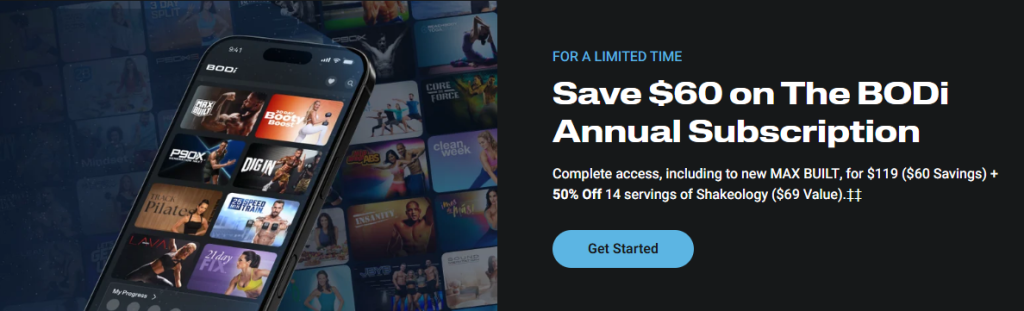
BODi uses both monthly and annual subscription structures, with pricing and promotional terms changing over time. The current U.S. subscription page lists complete BODi access at $19 per month after a seven-day free trial, while an annual offer is currently advertised at $119 for the first year before renewal at the regular $179 annual rate. BODi also maintains a separate 10 Minute BODi option, currently listed at $10 per month after a 10-day free trial, providing access to more than 400 short workouts and dedicated short-form programs. These options create a meaningful distinction between users seeking the full ecosystem and those primarily interested in brief workouts. The annual plan can reduce the effective monthly cost when the promotional rate applies, but the renewal price should be considered when assessing longer-term value. BODi also states that its plans are backed by a 31-day money-back guarantee, subject to terms and exclusions. Pricing therefore needs to be assessed alongside how much of the broader workout, nutrition, and community library a subscriber expects to use. For someone using several programs each month, the wider catalog can make the subscription more versatile than paying for individual training products, whereas a casual user may place greater importance on the shorter-term option.
BODi Pricing and Subscription Value

BODi can serve several different fitness routines because its content is not tied to one workout length or training environment. A beginner can use introductory programs and lower-impact sessions to establish a routine, while a more experienced participant can choose strength, HIIT, cardio, or established programs such as P90X and INSANITY. Users with limited time can build routines around 10-minute sessions, while people training at home can use longer programs with optional equipment. The nutrition component adds practical support for users who want meal planning alongside exercise, with the platform currently advertising more than 1,000 recipes and several nutrition plans. Families can also use separate profiles within a household, allowing individual progress and histories to remain distinct. For professionals or travelers, cross-device access makes it possible to continue a program without relying on a fixed gym location. These use cases illustrate that BODi is most useful as a recurring training environment rather than a one-off workout purchase, particularly for people who appreciate having multiple formats available within one membership. The platform’s combination of short classes, longer programs, nutrition material, and community access also makes it possible to adapt a routine as priorities change without moving to another service.
BODi Practical Applications and Market Position
BODi occupies a distinctive position among digital fitness subscriptions because it combines a very large workout archive with structured programs, nutrition content, community access, and an established catalog of recognizable training brands. Its scale gives subscribers considerable choice, while newer offerings such as 10 Minute BODi show an effort to accommodate shorter, habit-oriented exercise formats alongside longer programs. The platform also sells supplements and other fitness products, including Shakeology, Energize, Recover, creatine, collagen, and electrolyte products, extending its ecosystem beyond digital workouts. This creates a broader commercial model than a standalone exercise-streaming app. From a user perspective, the central question is less about the availability of individual workouts and more about whether the combination of programming, nutrition, community, device access, and recurring content fits a particular routine. BODi’s strongest differentiation is the integration of these components under one service, while the size of its catalog means that users may need to spend time selecting the programs and features that match their goals. Its current offering positions BODi as a comprehensive home-fitness platform rather than a single-program workout service, with an ecosystem that can accommodate both structured training and more flexible, on-demand use.