

BLUETTI IT presents the Elite 100 V2 as a compact portable power station designed to bridge the gap between everyday device charging, outdoor electricity, and short-term backup power. The model combines a 1,024 Wh LiFePO4 battery with a rated output of 1,800 W, giving it considerably more capability than small power banks while remaining more portable than many high-capacity home backup systems. The Elite 100 V2 is part of BLUETTI IT’s broader portfolio, which currently spans compact power stations, larger Elite and Apex models, solar panels, expansion batteries, chargers, and equipment intended for home, camping, and recreational-vehicle applications. The Italian store currently lists the Elite 100 V2 alongside products such as the Elite 30 V2, Elite 200 V2, Elite 300, Elite 400, and Apex 300, placing it in a middle category where portability and electrical output are both important. This review examines the Elite 100 V2 as a product while also considering how it fits into BLUETTI IT’s wider energy ecosystem
BLUETTI IT Elite 100 V2 Design and Build
The physical design of the BLUETTI Elite 100 V2 focuses on making a relatively high-capacity battery system easier to transport and position. BLUETTI IT lists the unit with a capacity of 1,024 Wh and 1,800 W output, while the company’s Italian content describes a compact 17-liter format, a hidden handle, and a weight of approximately 11.5 kg. That combination gives the Elite 100 V2 a practical form for moving between a home office, vehicle, campsite, or temporary work area without requiring the bulk associated with larger backup systems. The enclosure is designed around functional access rather than elaborate styling, with connection points arranged for different charging and power requirements. The use of a LiFePO4 battery chemistry is particularly relevant for a device intended for repeated cycling, because BLUETTI specifies more than 4,000 cycles for the battery.
BLUETTI IT Elite 100 V2 Power and Battery Features
The technical configuration is the central feature of the BLUETTI Elite 100 V2. Its 1,024 Wh capacity provides substantially more stored energy than compact USB power banks, while its 1,800 W rated output allows it to operate a broader range of household and recreational equipment. BLUETTI IT states that the unit can provide power for computers, projectors, refrigerators, fans, lighting, and selected higher-demand appliances, although actual runtime depends on the load, conversion losses, operating conditions, and battery level. The power station also incorporates multiple output ports so users can operate or recharge several devices from the same battery. BLUETTI describes the Elite 100 V2 as having seven output ports on its Italian product information, while other published material references nine output ports depending on the configuration or description being presented, so users should verify the exact port layout supplied with the selected regional version.
BLUETTI IT Elite 100 V2 Charging and Connectivity
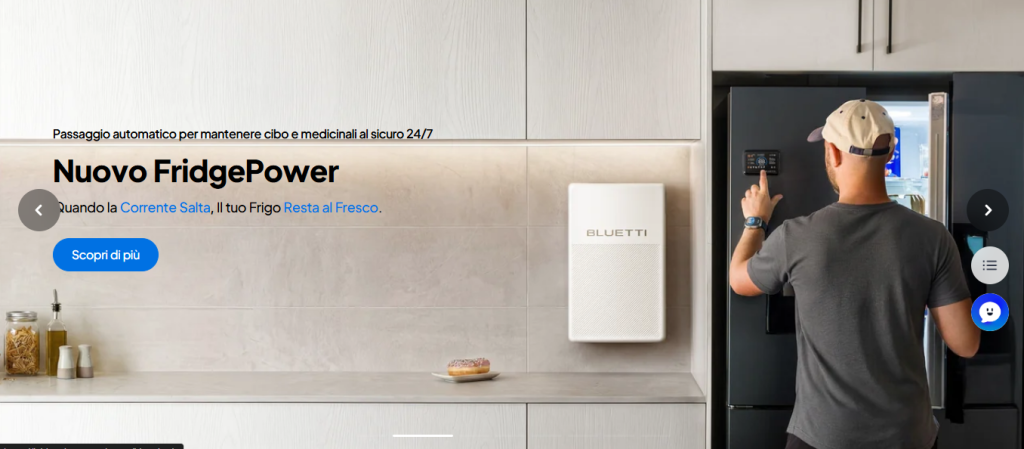
Charging flexibility is another important part of the Elite 100 V2 experience. BLUETTI IT states that the model can reach 80% charge in approximately 45 minutes using its 1,200 W AC charging capability, giving users a relatively short recovery period between uses. Solar charging is also supported, with the company specifying up to 1,000 W of solar input and an integrated MPPT system for managing solar energy conversion. This makes the unit suitable for situations where conventional electricity is unavailable, including camping, remote work, and emergency preparation. The platform also supports vehicle charging through compatible equipment, expanding the number of environments in which the power station can be replenished. BLUETTI’s wider ecosystem includes accessories such as Charger 1, a 560 W alternator charger, as well as solar panels and other charging equipment. The Elite 100 V2 therefore works not simply as a standalone battery but as part of a larger charging ecosystem in which AC, solar, and vehicle-based energy sources can be combined according to the user’s circumstances.
BLUETTI IT Elite 100 V2 Controls and Everyday Usability
For everyday operation, the Elite 100 V2 is designed around relatively direct controls and a portable format that does not require permanent installation. The compact enclosure allows users to move the unit between different locations, while the available display and connection layout provide information about power use, charging status, and remaining energy. The product is also compatible with BLUETTI’s app-based monitoring approach on supported configurations, giving users an additional way to manage or observe the power station. This can be useful when the unit is positioned in a camper, workspace, or backup location where physically checking the front panel is inconvenient. BLUETTI IT’s product ecosystem further supports comparison between models according to capacity and output, with the Elite 30 V2 offering 288 Wh and 600 W, the Elite 200 V2 providing 2,073.6 Wh and 2,600 W, and larger Elite and Apex models extending capacity and output considerably further.
BLUETTI IT Elite 100 V2 Backup Performance
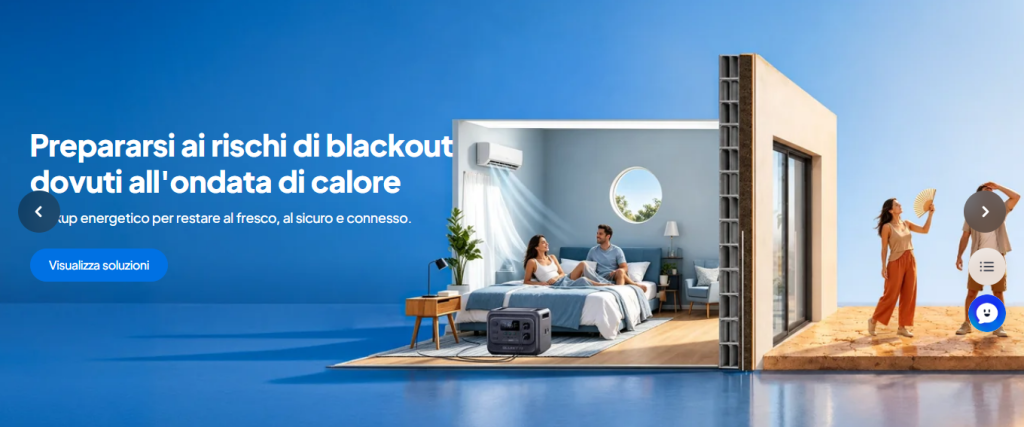
The Elite 100 V2 has several characteristics that make it relevant for backup applications rather than simple recreational charging. BLUETTI specifies a UPS switching time of approximately 10 milliseconds, allowing compatible equipment to remain powered during brief interruptions when the system is configured appropriately. This can be particularly useful for computers, networking equipment, lighting, and other electronics where a sudden loss of power could interrupt ongoing work. BLUETTI IT also promotes the model for emergency scenarios and gives indicative operating examples, including extended operation for low-power lighting, multiple smartphone charges, laptop use, refrigerators, and fans. These figures should be treated as estimates rather than guaranteed runtimes because actual performance changes according to device consumption and operating conditions. The unit’s 1,800 W output also has to be considered alongside the starting and running requirements of individual appliances.
BLUETTI IT Elite 100 V2 Pricing and Product Ecosystem
Pricing for the BLUETTI Elite 100 V2 varies according to promotions, bundles, and the configuration selected. At the time of the latest BLUETTI IT catalog data, the standard Elite 100 V2 was listed at €549 against a displayed reference price of €699, while versions bundled with solar panels or other accessories were priced differently. The wider Italian catalog demonstrates how BLUETTI structures its product range across different budgets and capacity requirements. Smaller products such as the Elite 10 are positioned around 128 Wh, while the Elite 30 V2 provides 288 Wh and the Elite 200 V2 increases capacity to 2,073.6 Wh. Higher-capacity models such as the Elite 300, Elite 400, and Apex 300 move into substantially larger energy-storage categories. BLUETTI IT also sells solar panels, expansion batteries, alternator chargers, and other accessories, allowing the initial power station to become part of a broader setup. Consequently, evaluating the Elite 100 V2’s cost involves considering not only its standalone price but also whether the user needs additional charging equipment or expansion components.
BLUETTI IT Elite 100 V2 Applications for Home and Outdoor Use
The range of potential applications is one of the most useful aspects of the BLUETTI Elite 100 V2. At home, its 1,024 Wh capacity and 1,800 W output can support selected appliances and electronics during outages, while its UPS capability can help maintain continuity for networking equipment or computing setups. For remote workers, the combination of laptop, monitor, router, lighting, and communication-device support makes it relevant to temporary power interruptions. Outdoor users can apply the same characteristics to camping equipment, portable refrigerators, lights, fans, drones, and other recreational electronics. BLUETTI IT also promotes the Elite 100 V2 for camper and caravan use, where access to mains electricity can vary between locations. Its solar compatibility adds another dimension for longer off-grid periods, although the practicality of solar charging depends on available sunlight, panel configuration, weather, and daily energy consumption.